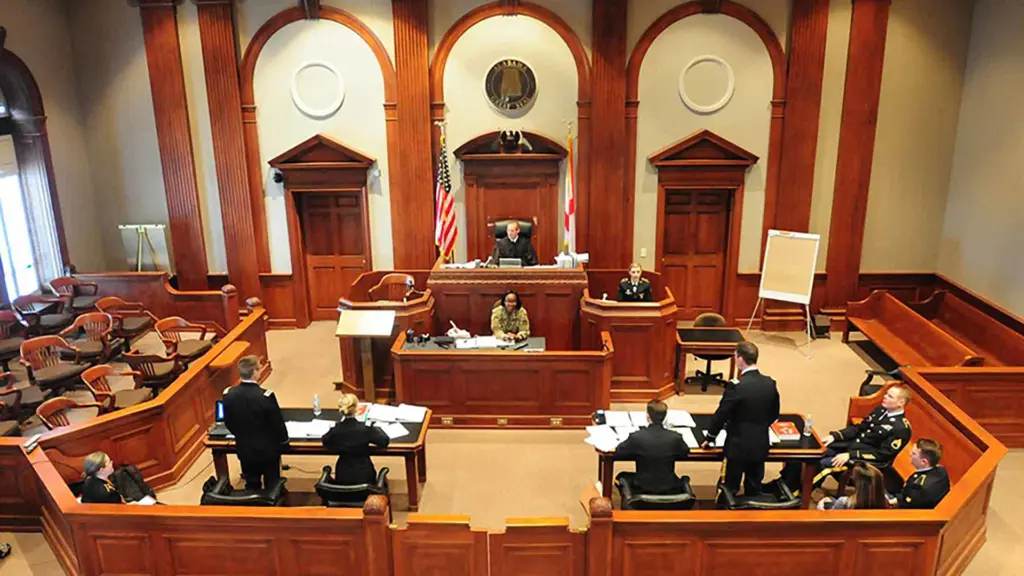
The 167th JAG section and the Alabama National Guard Trial Defense Service finishes a mock trial, Aug. 8, 2018, at the Calhoun County Courthouse, Anniston, Alabama. (Army National Guard photo by Staff Sgt. Katherine Dowd.)
MILITARY ORDERS 101—SIX MEMBERS OF CONGRESS TRY TO TAMPER WITH WELL-SETTLED MILITARY DISCIPLINE AND POLICY
INTRODUCTION AND BACKGROUND
I write this as a former Navy Lieutenant and Judge Advocate who tried cases all over the world and saw firsthand the professionalism and dedication to duty and orders shown by our military. Although my service was primarily with the Navy and serving select Marine Corps members, I know that our military members know exactly what their obligations are, and the irresponsible political theater engaged in by these so-called former spooks and military members changes nothing. Yes, they should be condemned and suffer the political accountability that should follow from their actions in urging members to “disobey illegal orders”; however, calling for their prosecution over their recital of existing and longstanding military law is equally irresponsible. It was neither sedition nor treason, and the protections of both their Office and the First Amendment offer them cover. I will not waste time urging such prosecution and “sedition” nonsense. The President and the Secretary of War should have taken the high road and directed the various service Judge Advocate Generals—all flag level—to set the record straight in a public announcement as well as a debrief of their chains of command and make fools out of these political hacks. Enough said. What is an “illegal order”? The Ridiculous Six couldn’t name any because none have presumably been given, and those given have been the result of legal opinion and operational necessity.
In recent days, however, it has been suggested that Secretary of War Hegseth ordered a second strike on a drug boat when it was determined that survivors were clinging to wreckage in open seas. If true, this may well be on the cusp of illegality, and if a service member refused to participate, the military trial of the new century would convene, and the entire operation would be cast into the public eye. Would such a member violate the Articles of the Uniform Code of Military Justice regarding disobedience of orders if he or she refused to kill “combatants” or “irregular warriors” who were helpless, offering no resistance, and in a position of de facto surrender? Let’s discuss with some black letter law and precedent.
THE LAW
The Manual for Courts-Martial has been updated a few times since I left active duty in 1986, but the fundamentals of what is a lawful order, which must be presumed to be obeyed, have changed little, if at all, and the relevant portions of two Editions are set forth below:
“Manual for Courts-Martial, United States pt. IV, para. 14.c.(2)(a)(i) (2005 ed.) (MCM), states:
An order requiring the performance of a military duty or act may be inferred to be lawful, and it is disobeyed at the peril of the subordinate. This inference does not apply to a patently illegal order, such as one that directs the commission of a crime.
It is a defense to any offense that the accused was acting pursuant to orders unless the accused knew the orders to be unlawful or a person of ordinary sense and understanding would have known the orders to be unlawful.
The test for assessing the lawfulness of an order under Article 92 comes from paragraph 14c(2)(a)(iii), Part IV, Manual for Courts-Martial, United States (1995 ed.), which states in pertinent part:
The order must relate to military duty, which includes all activities reasonably necessary to accomplish a military mission or safeguard or promote the morale, discipline, and usefulness of members of a command and directly connected with the maintenance of good order in the service. The order may not, without such a valid military purpose, interfere with private rights or personal affairs. However, the dictates of a person’s conscience, religion, or personal philosophy cannot justify or excuse the disobedience of an otherwise lawful order.”
It is not a defense for a military member to claim that the order is illegal based on his interpretation of applicable law. An order is presumed to be lawful, and the member, in defense of any discipline, has the burden to prove illegality unless the order is palpably illegal on its face. If so, the “order” has no legal effect and is a nullity. This does not, however, allow a soldier to disobey an order because he believes it to be palpably illegal. I have previously urged that all of this is well known to our military from basic training onward. For example, in the United States Army, this is fundamental procedure. For example:
“The Soldier’s Guide teaches junior enlisted soldiers to:
- Obey the lawful orders of NCOs and officers.
- Treat others with dignity and respect.
- Complete each task to the very best degree possible and not just to standard.
- Maintain a military appearance.
- Maintain individual physical fitness standards and readiness.
- Maintain individual equipment and clothing to standard.
Dep’t of Army Training Circular 7-21.13, Soldier’s Guide [Soldier’s Guide], para. 4-9 (30 Nov. 2015).”
The Uniform Code of Military Justice, which is also codified in the United States Code, defines two species of orders violations. Article 92 is more commonly charged and presumes that an order was disobeyed, but with a degree of recklessness or heedlessness in the form of rationalization. Article 90 establishes a willful and intentional violation and is considered the more serious. Depending on the degree of violation, the nature of the order, and whether it took place in a time of de facto war or hostilities, such an offense can be tried at a General Court Martial, which is empowered to adjudge serious prison time or even death. Here are the relevant statutes:
Ҥ 892. Art. 92. Failure to obey order or regulation
Any person subject to this chapter [10 USCS §§ 801 et seq.] who—
- (1) violates or fails to obey any lawful general order or regulation;
- (2) having knowledge of any other lawful order issued by a member of the armed forces, which it is his duty to obey, fails to obey the order; or
- (3) is derelict in the performance of his duties;
shall be punished as a court-martial may direct.
§ 890. Art. 90. Willfully disobeying superior commissioned officer
Any person subject to this chapter [10 USCS §§ 801 et seq.] who willfully disobeys a lawful command of that person’s superior commissioned officer shall be punished—
- (1) if the offense is committed in time of war, by death or such other punishment as a court-martial may direct; and
- (2) if the offense is committed at any other time, by such punishment, other than death, as a court-martial may direct.”
UNITED STATES V. CALLEY—A HIGHLY PUBLICIZED TEST OF THE “ORDERS” DEFENSE IN A WAR WHEREIN THE ENEMY WAS NEVER FULLY DEFINED
Prior to entering law school and during my time there, I was influenced by the writings of some Army Judge Advocates who wrote of the moral and legal complexities of defending homicide cases in Vietnam during a time of guerilla warfare wherein civilians would routinely attack Americans who killed them at their peril. Even known sympathizers who provided information and shelter to the Viet Cong and would set booby traps and snipe at soldiers from places of concealment would present as “innocent” civilians who were killed by 19-year-old soldiers who were thrust into this conflict, poorly trained and led, and had seen their platoon mates killed by “civilians.” They did not “murder,” their attorneys claimed; they were engaging those who they knew would kill them when they were walking out of a village and were within rifle range. I also recommend the movie “Breaker Morant” as an example of the ethical and moral principles at play when a soldier is in a guerilla war and the enemy wears civilian clothes. Scapegoat or war criminal?
Second Lieutenant William Calley was rushed through basic and advanced infantry training after volunteering for the Army in 1967 and then entered a 26-week Officer Candidate School course at Fort Benning, GA. He was below average in both intelligence and performance but was pushed through due to manpower issues when the life expectancy of a Second Lieutenant Platoon Leader in Vietnam was measured in weeks. By 1968 he was a Platoon Leader in Company C, 1st Battalion, 20th Infantry Regiment, 23rd Infantry (Americal Division). The Company had fought off the Tet Offensive along with several formations of soldiers and Marines all throughout Vietnam. They lost 28 of their members and by March of 1968, experiencing low morale. His Company was part of Task Force Barker stationed in an area known as “Pinkville”—mines and booby traps would render a human body into a “pink mist”—hence the name. Indeed, around the village of My Lai in Quang Ngai Province, Lieutenant Calley’s unit would sustain many casualties from mines, sniper fire, automatic weapons fire, and other forms of attack. Intelligence reports established that this was a major Viet Cong stronghold. Indeed, at a memorial service for those killed in the previous weeks held on March 15th, 1968, Captain Ernest Medina, Company “C” Commander, had ordered a search and destroy mission on My Lai 4, one of four (4) sectors of the village assigned to Second Lieutenant Calley. He was to lead the mission on March 16th. The background facts were noted by the Court of Military Appeals reviewing Lieutenant Calley’s ultimate conviction for 22 counts of murder:
“Lieutenant William Calley was a platoon leader in C Company, a unit that was part of an organization known as Task Force Barker, whose mission was to subdue and drive out the enemy in an area in the Republic of Vietnam known popularly as Pinkville. Before March 16, 1968, this area, which included the village of My Lai 4, was a Viet Cong stronghold. C Company had operated in the area several times. Each time the unit had entered the area, it suffered casualties by sniper fire, machine gun fire, mines, and other forms of attack. Lieutenant Calley had accompanied his platoon on some of the incursions. On March 15, 1968, a memorial service for members of the company killed in the area during the preceding weeks was held. After the service Captain Ernest L. Medina, the commanding officer of C Company, briefed the company on a mission in the Pinkville area set for the next day. C Company was to serve as the main attack formation for Task Force Barker. In that role it would assault and neutralize My Lai 4, 5, and 6 and then mass for an assault on My Lai 1. Intelligence reports indicated that the unit would be opposed by a veteran enemy battalion and that all civilians would be absent from the area. The objective was to destroy the enemy. Disagreement exists as to the instructions on the specifics of destruction. Captain Medina testified that he instructed his troops that they were to destroy My Lai 4 by ‘burning the hootches, to kill the livestock, to close the wells and to destroy the food crops.’ Asked if women and children were to be killed, Medina said he replied in the negative, adding that, ‘You must use common sense. If they have a weapon and are trying to engage you, then you can shoot back, but you must use common sense.’ However, Lieutenant Calley testified that Captain Medina informed the troops they were to kill every living thing—men, women, children, and animals—and under no circumstances were they to leave any Vietnamese behind them as they passed through the villages en route to their final objective. Other witnesses gave more or less support to both versions of the briefing.”
Upon entering the village, there were old men, women, and children, and most likely, as was common, the Viet Cong they supported had faded away. They were certainly sympathizers. Calley and his men herded them to the outskirts of the village, and Calley ordered them shot. They were unarmed and de facto prisoners who posed no military threat to Calley or his men. Many were beaten before being shot. Several privates flat out refused Calley’s orders to kill. One refused to give his machine gun to Calley to kill the unarmed civilians. Some in nearby units moved to block the carnage, and a helicopter pilot flew some of the civilians to safety.
In time, and after many came forward to report these atrocities, the Army charged several officers and enlisted with murder. Calley’s was the sole conviction at trial. Until then the Army had reported the mission as a “successful search and destroy mission.” Lt. Calley’s defense team, in a trial that lasted four months, contended that he was following Captain Medina’s order to “kill everyone” and destroy the village and that, accordingly, he did not and could not form the specific intent to kill required for murder because he had an honest belief that all of the detainees were the “enemy.” He was convicted and sentenced to life imprisonment. The convening authority reduced the sentence to 20 years. President Nixon, reacting to some of the public sentiment which regarded Calley as a scapegoat for the Army, ordered him held on house arrest. Ultimately, he served about three years and died at age 80 in Gainesville, Florida, in 2024. The legal issues of the lawfulness of an order to “kill everyone” were discussed by the Military Appeals Court reviewing the conviction, and the instructions to the jury were validated as a correct statement of the law. The jury was instructed as follows:
“A determination that an order is illegal does not, of itself, assign criminal responsibility to the person following the order for acts done in compliance with it. Soldiers are taught to follow orders, and special attention is given to obedience of orders on the battlefield. Military effectiveness depends upon obedience to orders. On the other hand, the obedience of a soldier is not the obedience of an automaton. A soldier is a reasoning agent, obliged to respond, not as a machine, but as a person. The law takes these factors into account in assessing criminal responsibility for acts done in compliance with illegal orders. The acts of a subordinate done in compliance with an unlawful order given him by his superior are excused and impose no criminal liability upon him unless the superior’s order is one which a man of ordinary sense and understanding would, under the circumstances, know to be unlawful, or if the order in question is actually known to the accused to be unlawful.
The killing of resisting or fleeing enemy forces is generally recognized as a justifiable act of war, and you may consider any such killings justifiable in this case. The law attempts to protect those persons not actually engaged in warfare, however; and limits the circumstances under which their lives may be taken. Both combatants captured by and noncombatants detained by the opposing force, regardless of their loyalties, political views, or prior acts, have the right to be treated as prisoners until released, confined, or executed, in accordance with law and established procedures, by competent authority sitting in judgment of such detained or captured individuals. Summary execution of detainees or prisoners is forbidden by law. Further, it’s clear under the evidence presented in this case, that hostile acts or support of the enemy North Vietnamese or Viet Cong forces by inhabitants of My Lai 4 at some time prior to 16 March 1968, would not justify the summary execution of all or a part of the occupants of My Lai 4 on 16 March, nor would hostile acts committed that day, if, following the hostility, the belligerents surrendered or were captured by our forces. I therefore instruct you, as a matter of law, that if unresisting human beings were killed to My Lai 4 while within the effective custody and control of our military forces, their deaths cannot be considered justified, and any order to kill such people would be, as a matter of law, an illegal order. Thus, if you find that Lieutenant Calley received an order directing him to kill unresisting Vietnamese within his control or within the control of his troops, that order would be an illegal order…. Enemy prisoners are not subject to summary execution by their captors.”
Military law has long held that the killing of an unresisting prisoner is murder. Winthrop’s Military Law and Precedents, 2d ed., 1920 Reprint, at 788-91. The well-settled military law would hold that any order to kill civilians or unarmed prisoners would presumably be illegal.
NOT SO IN THE CASE OF MOST OPERATIONAL ORDERS
Military courts have upheld convictions for failing to wear prescribed uniform items. In the United Nations peacekeeping functions in Yugoslavia, a U.S. soldier refused to wear the regulation UN blue cap and shoulder patches on his uniform, objecting on political grounds. That was not for him to do, and the lawfulness of the order was upheld. A Fort Hood soldier was ordered to stay on post, and he left for personal reasons. No defense to the orders violation. An Army member had refused to take a pre-deployment Anthrax injection stating it was “experimental” and he didn’t want it. His orders violation was upheld. There are many such examples, as the military must operate with conformance to orders in the interest of discipline and mission readiness. No one is sure what the Ridiculous Six were getting at. An order for the National Guard to federalize and report for duty is lawful from a military discipline standpoint, and a failure to mobilize would be a serious violation. The fact that federal courts may have differing views on the legality of deployment is of no concern to the deployed soldier. The orders to interdict and destroy drug boats are presumably lawful and must be followed given the designation of these personnel as irregular warriors and the determination that such members are part of militarized cartels killing Americans with drugs instead of bullets. The problem arises when those who are rendered powerless to run or continue their mission and are in de facto custody are killed by orders after the initial strike.
CONCLUSION
ALL orders relating to military duty are presumed lawful. The law is clear and known generally by every reasonable member throughout the ranks. Each unit has a legal officer, and around the world, Judge Advocates and Legal Officers can provide counsel and advice. ALL members are charged with the knowledge of the Uniform Code of Military Justice and the presumption of legality. The Ridiculous Six, engaged in a shameless example of political theater, insulted the intelligence and integrity of those in uniform and, frankly, to use a phrase, beclowned themselves.
Mike Imprevento
December 1st, 2025