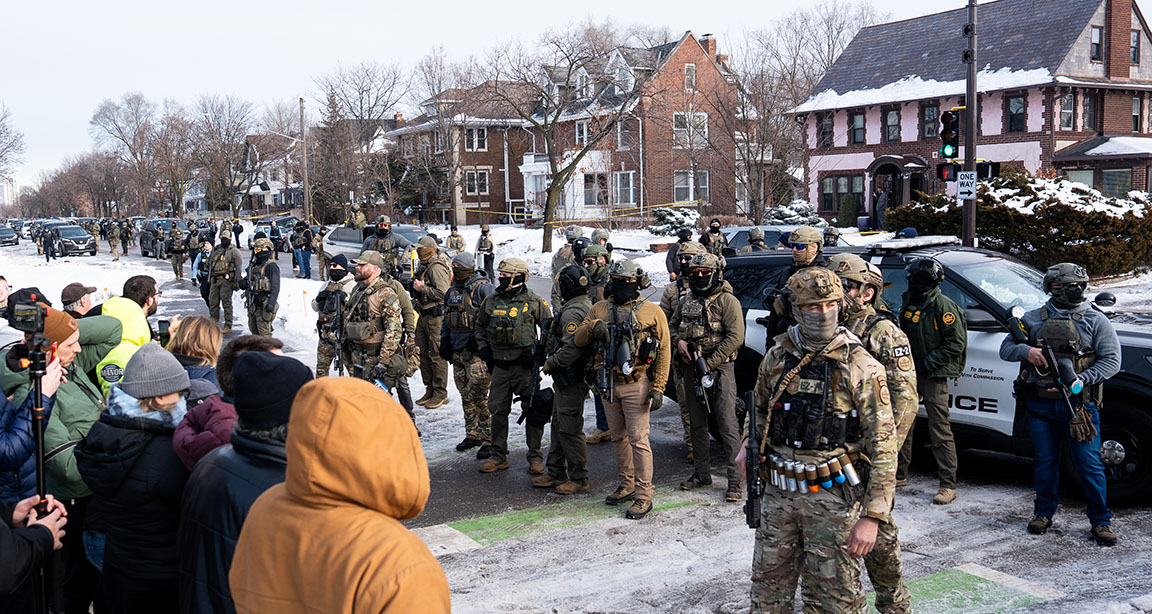
ICE Agents in Minneapolis After Shooting. Photo by Chad Davis licensed under CC BY 4.0.
AN ICE AGENT USES DEADLY FORCE IN MINNEAPOLIS—WHAT WILL LIKELY FOLLOW
INTRODUCTION AND BACKGROUND
It is a certainty that the death of Renee Good in Minneapolis is a tragedy. It is rendered more tragic in that she inserted herself into a dangerous situation as part of a nationwide effort by anti-immigration groups such as ICE Watch, an organization committed to skirting the gray area between protest and unlawful obstruction nationwide. ICE agents enforcing federal laws have been the subject of political invective by state and local elected sanctuary city clowns who cheerlead these people into a very dangerous game of obstruct and divert under the pretext of “protest.” Federal agents have been attacked nationwide in shocking numbers. They fear for themselves and their families every day. Nevertheless, a wife and mother is dead, and legitimate federal enforcement efforts are in political jeopardy as the midterms loom.
It could also have been avoided by the agent, overworked and previously injured by just such an activist, sidestepping the vehicle and seeing to the ultimate arrest of the deceased by less than lethal means. Both DHS policy and the policies of most police agencies are to avoid, indeed, to prohibit, shooting into moving vehicles or any occupied vehicle except as a last resort when no other means of escape is practicable. The uncertainties of what might happen in such an instance, including the harm posed to bystanders, have shaped these policies as the result of real-world tragedies, from shooting at tires and missing, hitting bystanders, to a dead or wounded driver still on the accelerator plowing into innocents in the vicinity.
The critical issues here are that such policies are procedural but do not define the well-settled law of self-defense, the use of lethal force, immunity, and similar issues. These policies are internal and for training or discipline, but DO NOT CREATE OR PREEMPT LAW or create substantive rights. They are of limited value in determining the ultimate issues in any state criminal case, which is sure to come. It still lurks in the background.
Minnesota officials will indict the agent for murder. They have forecast as much in their press conferences. This is the political move and is well timed to remove the fraud issue from the headlines. They have enough for a probable cause-driven indictment. Here is what happens next. Read on.
SUPREMACY CLAUSE IMMUNITY WILL BE ASSERTED BY THE UNITED STATES IN DEFENSE OF ITS INTERIOR ENFORCEMENT INITIATIVES
The analysis presented herein is taken from the frequently cited case of Wyoming v. Livingston, 443 F.3d 1211, 1230 (10th Cir. 2006), which affirmed complete immunity for federal wildlife agents charged with state offenses as the result of a wolf collaring program under federal law—a law unpopular in Wyoming. Federal officers were charged with trespassing and littering for entering upon private land to collar wolves for the tracking of their movements. I quote heavily herein from the Court’s analysis ultimately upholding the District Court’s finding of complete Supremacy Clause immunity under those facts and applicable law.
The framers of the American federal system expected the federal and state governments each to check the abuses of the other. See The Federalist No. 28, at 179 (Alexander Hamilton) (Jacob E. Cooke ed., 1961). (“[T]he General [i.e., federal] Government will at all times stand ready to check the usurpations of the state governments; and these will have the same disposition towards the General Government. If [the rights of the people] are invaded by either, they can make use of the other as the instrument of redress.”); The Federalist No. 51, at 351 (James Madison) (“In the compound republic of America, a double security arises to the rights of the people. The [state and federal] governments will controul each other; at the same time that each will be controulled by itself.”). The flipside of this mutual checking function, however, is the danger that one level of government would improperly restrict the other, and especially that states would impede or frustrate the legitimate execution of federal law. To prevent this second evil, federal officers have long been held immune from state prosecutions for actions reasonable and necessary in the discharge of their federal responsibilities. See, e.g., In re Neagle, 135 U.S. 1 (1890); Ohio v. Thomas, 173 U.S. 276 (1899). This immunity is rooted in the Supremacy Clause of the United States Constitution, which provides:
“This Constitution, and the Laws of the United States which shall be made in Pursuance thereof; and all Treaties made, or which shall be made, under the Authority of the United States, shall be the supreme Law of the Land; and the Judges in every State shall be bound thereby, any Thing in the Constitution or Laws of any State to the Contrary notwithstanding. U.S. Const. art. VI, cl. 2.”
Although the Supremacy Clause explicitly refers only to the “Constitution” and “Laws,” its implication is that states may not impede or interfere with the actions of federal executive officials when they are carrying out federal laws. As Chief Justice John Marshall maintained in the great case of McCulloch v. Maryland, 17 U.S. (4 Wheat.) 316, 436, 4 L.Ed. 579 (1819), “the states have no power, by taxation or otherwise, to retard, impede, burden, or in any manner control, the operations of the constitutional laws enacted by Congress to carry into execution the powers vested in the general government.” It is not necessary for Congress to provide expressly for such immunity in the statutes under which federal officials act; Supremacy Clause immunity is “incidental to and is implied in the several acts by which these [federal] institutions are created and is secured to the individuals employed in them by the judicial power alone.” Osborn v. Bank of United States, 22 U.S. (9 Wheat.) 738, 865-66, 6 L. Ed. 204 (1824) (Marshall, C.J.).
ANY INEVITABLE STATE PROSECUTION OF THE AGENT WILL BE REMOVED TO A MINNESOTA FEDERAL DISTRICT COURT—A LONGSTANDING PROTECTION OF FEDERAL FUNCTIONS
Specifically, 28 U.S.C. § 1442 allows federal officials to move criminal prosecutions that are brought against them from state to federal court if the case relates to the official’s employment. The federal agent who used deadly force in Minneapolis was clearly working directly in the scope of his enforcement tasks directed by ICE and under color of law while wearing his badge and issued equipment. He had previously been dragged by a car and seriously injured only a few months prior. Undoubtedly, his unit had been briefed on the actions of ICE Watch operations by untrained activists across the United States, as well as the national database of violent acts against ICE agents. These include vehicles being used to block and ram agents as a game plan, all the way to gunfire and other forms of direct, potentially lethal force. To deny that ICE agents are in the crosshairs of pro-immigration fanatics as well as other anti-government anarchists is intellectual dishonesty of the lowest order. Digital surveillance of federal agents by organized and well-funded groups has increased the danger by a serious margin. That these actions are encouraged by elected officials is unacceptable and dangerous.
Related to the judicially created Supremacy Clause immunity doctrine are federal officer removal statutes. Like Supremacy Clause immunity, federal officer removal statutes are designed to protect the operations of the federal government from state interference. Despite their similarities, the principles are distinct. Supremacy Clause immunity, when properly established, provides an absolute immunity to prosecution. Federal officer removal statutes provide federal officers with a federal forum for the entire trial, including determinations of guilt or innocence as well as the applicability of official immunity. This protects against the possibility of a hostile state forum, which might arise when the federal officer is enforcing a locally unpopular national law. This is the exact scenario here when elected officials in Minnesota are openly hostile to federal immigration enforcement in Minneapolis and essentially encouraging obstruction and defiance of the law. Local police fail to back the federal law enforcement operations by order of the city leaders, who are all in for the defunding of all police and have been since George Floyd. Local police can enforce unlawful assembly declarations or set trespass zones to facilitate safe zones. They refuse. It is a politically expedient move, and they also bear responsibility.
These are the issues that any United States District Court must decide in a determination of whether the matter will be dismissed in its entirety, and federal courts have long said that federal officials are insulated from state prosecutions if:
“(1) the federal official was doing something authorized by federal law, and (2) the official’s actions were ‘necessary and proper’ in fulfilling their federal duties.”
There are some disputes as to what level of knowledge on the part of the federal officer the “necessary and proper” analysis involves. In deciding whether an officer’s actions are “necessary and proper,” some courts consider the officer’s subjective beliefs, some look to whether the actions were objectively reasonable, and others evaluate both subjective and objective considerations. There is little guidance on this, and it is an open question. I forecast that the following will involve a subjective analysis of what the agent “reasonably” perceived based upon the following allegations:
- The agent’s actions were authorized clearly by federal law in enforcing exclusively federal immigration laws through a sweep in public spaces;
- His order and the other orders of ICE agents to the deceased operator of the automobile to exit the vehicle were ignored;
- She at that time had been engaged in interference and obstruction of ICE activity as part of the ICE Watch intent—this was a federal crime, and there was at least reasonable suspicion to investigate this and to stop her;
- She ignored his clear and lawful command to stop the vehicle and exit it;
- She heard his order;
- Despite hearing the command, she fled the scene and in so doing placed the vehicle in a position such that the agent could reasonably believe that he was a target and therefore in fear of serious bodily harm or death—it appears the vehicle struck him as he tried to avoid it;
- The foregoing presents a colorable issue of an assault on a federal officer in violation of law whether he was hit or not;
- His use of deadly force is an amalgamation of apprehension by deadly force of a fleeing felon and the law of reasonable self-defense;
- He had been dragged before by a different subject in the summer, sustaining serious injury, and vehicles were used regularly to block, harass, and injure ICE agents in sanctuary cities nationally as part of the ICE Watch playbook;
- His subjective beliefs, therefore, must necessarily be part of the analysis by any court. That standard of review is not well settled.
CONCLUSION
The agent’s fate lies in the acumen and intellectual honesty of a federal judge, ultimately. A denial of complete immunity at the District Court level will be appealed, and it is all but certain that the Supreme Court will finally define the parameters of such immunity by hearing the appeal on an expedited basis. Most of the Court (Chief Justice Roberts the wild card) continue to believe in the continued existence of qualified immunity and, I suspect, will continue the long tradition of federal Supremacy Clause immunity for the public policy reasons that spawned the doctrine. This is a core separation of powers substantive law issue. That issue is complicated, however. If the court applies an objective or mixed standard, it may well be held that deadly force was not a “necessary and proper” component of the authorized task of enforcement in this instance. I predict that immunity will be granted and the matter dismissed; however, given the volatile environment these agents step into while enforcing laws that Congress enacted. The President may have pardon authority, but this is new territory for a state-generated criminal charge. He can pardon from any federal prosecution that might come later if the Democrats take the White House in 2028. They will run on this issue. Time will tell. Politics will long outlast the instant legal issues.
Mike Imprevento
January 12th, 2026